
“Nothing in all the world is more dangerous than sincere ignorance and conscientious stupidity” Martin Luther King Jr.”
I learned something at a late age a few days ago. I had a sore on my face and wanted to cover it with a bandage. I walked to my local Walgreens in San Francisco and bought a package. They matched my skin tone perfectly.
Later, the thought occurred to me, what if I were not a ‘white’ person? Surely these days, it must be easy to get bandages to match all skin shades. Guess what, it’s not. With a little help from Google, I found out they do exist (marketed under names like Ourtone and Tru-Color) They can be ordered online but only one ‘Target’ store currently has them in stock in San Francisco. So you can’t just walk into your local drugstore to buy them. I wonder which clinics, hospitals and schools have them.
From a 2013 article by Sebastian Malo in the Atlantic:
Orundu Johnson, a 66-year-old African American woman living in Harlem, remembers. “The bandages would say flesh color, and I’d explain to my kids, ‘Well, that’s not your flesh.”
Entrepreneur, Michael Panayiotis was frustrated by the placement of his product, ‘Ebon-Aide’, which usually ended up on separate shelves dedicated to satisfying the needs of Afro-American customers. “If you don’t show it to people, how are they going to buy it?” he said. He lost his investment and his company folded in 2002.

About Crayons
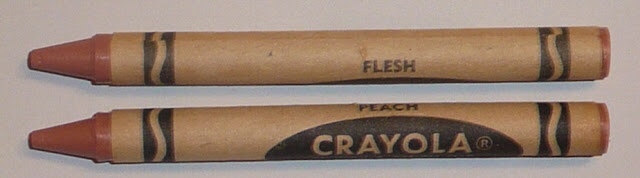
Then I remembered my first crayolas having a color labeled ‘flesh’ , a pinkish beige. It did not occur to my baby brain that there was any other color for skin. In 1962 the color was permanently renamed ‘peach’ due to the efforts of one smart woman, June Handler, who wrote to Crayola. They changed the name almost immediately.
June was doing doctoral research on “An Attempt to change kindergarten children’s attitudes of prejudice toward the negro”. She had always been concerned about black/white prejudice, especially in young children. In her abstract, the children who were five would make derogatory remarks about those who were black and she tried to help them understand prejudice and what it does.
In 1992 Crayola introduced a special crayola collection called ‘Colors of the World’ including 24 crayons to reproduce different skin tones. You can purchase them online. I do remember as a kid being frustrated trying to portray skin colors even for different ‘white’ people.
I did a statistically insignificant survey of my friends. One caucasian, a little older than me, who had been a teacher of special needs kids and had never before thought of the flesh color discrepancy, just took it for granted, like me. Another, a little younger, who came to this country as a child from India was always aware of the discrepancies. She simply started wearing dinosaur and cartoon bandages.
What else is there still for me to learn?
https://www.theatlantic.com/health/archive/2013/06/the-story-of-the-black-band-aid/276542/
http://crayoncollecting.blogspot.com/2018/05/the-real-tale-of-color-flesh.htm – post by Ed Heller, the crayon historian
 Living Well - Ongoing Adventures in Uncertainty
Flesh! What a vague and useless word when used as a color. And what a gift that your eyes were opened to the blindness of the culture to so many whose skin tone don’t match the band aid box. I, too, look for places where I have had the privilege of being oblivious. It’s a humbling and important education.
LikeLike
Well said! Yes it is a humbling gift. I still have so much to learn.
LikeLike